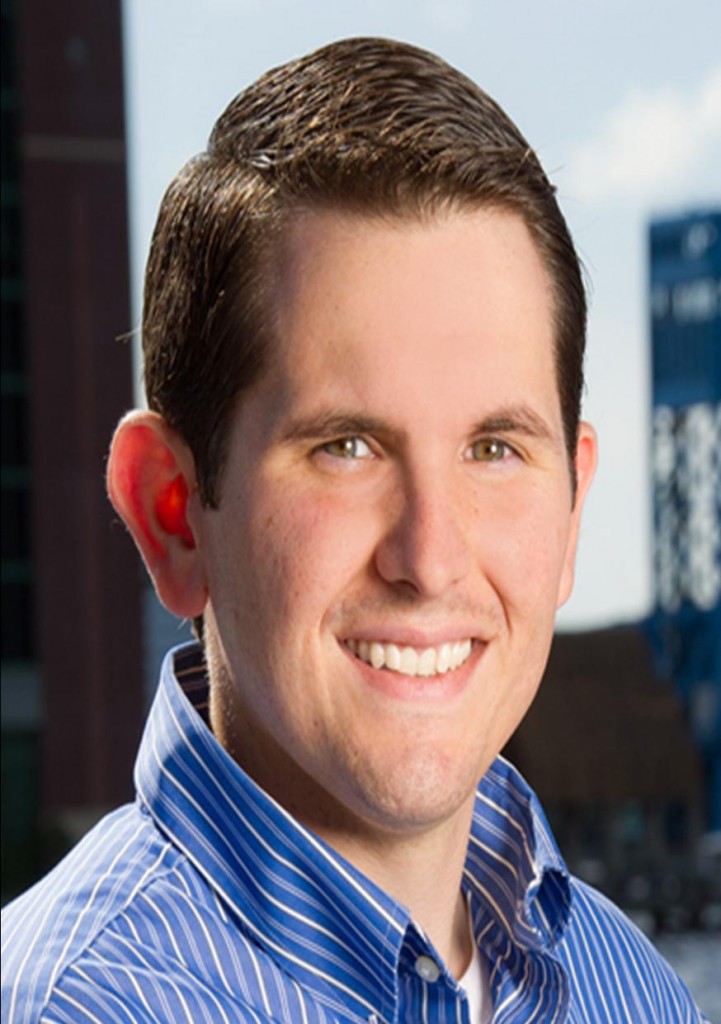
 It’s rare to find strong school choice advocates on local school boards. But in Florida, another such advocate has emerged as a viable candidate in one of the state’s biggest school districts.
Jason Fischer, 29, is one of six candidates running for the District 7 seat in Duval County, which is the county that corresponds with the city of Jacksonville. As we’ve noted before, Duval has been particularly unfriendly territory when it comes to charter schools, vouchers and tax credit scholarships. So it’s worth noting that not only is Fischer openly supportive of expanded school choice, including private options, but he’s no ordinary contender by other measures. Last month, Gov. Jeb Bush endorsed him. And yesterday, with less than three weeks to go before the Aug. 14 primary, three speaker-designates for the Florida House of Representatives did the same.
Like Glen Gilzean, a school board member and candidate in Pinellas County, Fla. who we’ve also written about (and who also snagged an endorsement from Bush), Fischer defies the caricature of the school choice supporter who wants to tear down traditional public schools. His platform is by no means limited to school choice; it includes, among other things, more focus on teacher quality and performance pay. But Fischer doesn’t shy from the potential benefits that come when more learning options are available to more kids.
“If the government has a good functioning school in an area, and people want to send their kids there, that’s fine,” Fischer told redefinED in a phone interview this week. “My goal isn’t to undercut public education. It’s to make sure parents have the widest opportunities available.”
“I think the choices will improve the quality of education of their child primarily,” he continued. “But secondarily, it will force the public school education system to improve its service level … so everyone benefits.”
Duval has struggled even more than most Florida urban districts to improve test scores for low-income students, and the School Board and one of the county’s key education advocacy groups have resisted more learning options for these students. But Fischer suggests that expanded choice can be part of the solution. (more…)
Pennsylvania: A budget deal expands the state's existing tax credit scholarship program and creates a new one aimed at helping students in struggling schools. (Philadelphia Inquirer)
 Washington: Bill Gates chips in $1 million for a ballot initiative to bring charter schools to one of the last states without any. (Associated Press) It appears supporters gathered enough signatures to get the initiative on the ballot. (Associated Press)
Florida: Former Gov. Jeb Bush endorses a local school board member who openly supports vouchers, tax credit scholarships and other forms of expanded school choice. (Tampa Bay Times) The incoming state House speaker also backs the board member. (Tampa Bay Times)
New Jersey: The state-appointed superintendent in Newark overrules a local advisory board and moves ahead with plans to lease empty buildings to charter schools. (NJ Spotlight)
Louisiana: State Superintendent John White continues to face criticism for his handling of a questionable private school that is seeking to participate in the state's new voucher program. (New Orleans Times Picayune) A state lawmaker now says she regrets voting for the program because she fears it will promote Islam. (Huffington Post)
California: The teachers union at Green Dot charter schools pushes for performance pay and evaluations tied to test scores. (Contra Costa Times)
Tennessee: A charter school operator vows to appeal to the state after a local school board rejects its plan to open charter schools in wealthy West Nashville. (The Tennessean)
Oklahoma: Online learning is growing more popular in Oklahoma, with supporters seeing it as an equalizer between districts that are big and small, rural and urban. (Tulsa World)
(Image from businessweek.com)
Discussions about how best to improve student learning often get contentious, so at redefinED we try to make a positive contribution by identifying areas of possible common ground and clarifying the historical record when we see errors or omissions. Rita M. Solnet’s recent Huffington Post column on how Florida might better utilize its standardized testing data gives us an opportunity to do both.
Rita is a founder of Parents Across America, a group that opposes excessive reliance on high-stakes standardized tests. And since Rita lives in Florida, she is particularly unhappy with how Florida uses – or, she would say, abuses - its state testing data. Rita ends her column with some ideas that provide the basis for common ground, but her piece also includes some erroneous Florida history, which I want to correct.
In 1991, the Florida Legislature passed the Education Reform and Accountability Act, commonly known as Blueprint 2000. Florida had experimented with giving teachers and schools more decision-making power in the late 1980s, and Blueprint 2000 was intended to accelerate this effort. The grand bargain was that state and local government would stop micromanaging schools in exchange for individual schools being held accountable for results.
While the legislation passed with strong bipartisan support, the primary advocates were all Democrats. They included Gov. Lawton Chiles, Lt. Gov. Buddy McKay, Commissioner of Education Betty Castor, Rep. Doug “Tim” Jamerson and Sen. George Kirkpatrick.
Two months after the legislation passed, the Florida Commission on Education Reform and Accountability was convened to create the legislatively mandated standards, assessments and accountability system. I was the teachers union president in Pinellas County in 1991, and Commissioner Castor appointed me to be one of three teacher representatives on the commission.
The U.S. Department of Labor released the Secretary of Labor's Commission on Achieving Necessary Skills (SCANS) report in June 1991, outlining the knowledge and skills students would need to succeed in the 21st Century. Our commission was impressed and decided to base Florida’s standards on the SCANS recommendations, which included literacy skills (reading, writing, mathematics), thinking skills (problem solving, decision making), personal qualities (honesty/integrity), resource management (time, money), information management (organizing, processing, interpreting), and technological competence.
Several commissioners argued that we could measure the SCANS standards using an International Baccalaureate-type assessment system that included multiple internal and external assessments, but the Florida Department of Education’s student testing staff strongly disagreed. Its concerns were legal and operational. (more…)
Washington D.C.: The Obama administration relents on funding for the D.C. voucher program and okays a deal that will allow a small expansion. (Washington Post)
New Hampshire: Gov. John Lynch (pictured here) vetoes a legislative proposal for tax credit scholarships, but some expect an override. (Concord Monitor)
Florida: Former Gov. Jeb Bush stresses school choice, accountability and common ground in a speech to Latino officials. (Associated Press)
North Carolina: A legislative proposal for tax credits scholarships has been rolled into a broader education reform bill in the state House. (Associated Press)
Pennsylvania: A proposed state budget would expand the tax credit scholarship program from $75 million to $150 million a year at the same time public school funding levels are kept the same. (Associated Press) The state senate passes a bill that would make it easier for traditional public schools to be converted into charter schools in financially troubled districts. (Bloomberg)
Colorado: Debate arises over the validity of a survey that finds a lack of support for the Douglas County School District's voucher program. (Education News Colorado) (more…)
 Beginning Monday, we have a special treat for you at redefinED - commentary about how far we've come with school choice in Florida, and where we may be headed.
The prompt for this came at an April meeting of the Florida Alliance for Choices in Education, which includes many of the state’s choice groups. An alliance member noted the national spotlight had shifted in recent years to states like Indiana and Louisiana. Had Florida, so long on the cutting edge of the choice movement, lost some of its mojo?
Clearly, Florida remains a national leader and a national model. But the comment made us wonder. What will school choice in Florida look like in five or 10 years? How do we best continue expanding options so students benefit?
We turned to former Florida Gov. Jeb Bush, Education Commissioner Gerard Robinson and other leading voices for choice and asked. Graciously, they offered their thoughts and visions, which we’ll be running all next week.
Individually, the contributions are thoughtful and thought provoking. Collectively, they offer the outlines of a bigger picture – not just of the future of school choice in Florida, but of the future of public education.
First up on Monday: Commissioner Robinson.
 A chain of Catholic, college-prep high schools that has demonstrated success with low-income students is eyeing two Florida cities for a possible expansion. Tampa and Miami are near the top of the list for the Chicago-based Cristo Rey Network, group president Rob Birdsell told redefinED. The reasons: A good job pool. The availability of tax credit scholarships. A need for more high-quality options for low-income kids. And maybe even some nudging from former Florida Gov. Jeb Bush.
“We very much want to get to Florida,” Birdsell said in a phone interview. “Gov. Bush is a friend of Cristo Rey (and) he is persistent.”
Lauded by education reformers and others for innovative work with Hispanic and African American students (see if you can get through this “60 Minutes” piece without crying), Cristo Rey now operates 24 Catholic high schools in 17 states and the District of Columbia. Its students typically come in two grade levels behind. But 84 percent of those who graduate enroll in college.
The students pay more than half of the $12,000 average tuition through a corporate work study program that gives them real-world experience at banks, hospitals, law firms and other partners. Accessing Florida’s tax credit scholarship program – worth $4,335 per student this fall – would fill out most of the remaining gap. That would take pressure off both the families and the network’s fundraisers. (more…)
 Colorado: Former Florida Gov. Jeb Bush lays out his education reform formula, with expanded school choice a key plank. (Education News Colorado)
Pennsylvania: Hundreds of Catholic school students in Philadelphia rally for a voucher bill. (CBS Philly)
Michigan: State lawmakers consider funding cyber schools on performance rather than enrollment. (MLive.com)
Washington: Expanded school choice in the form of charter schools - Washington is one of the few states without any - is an issue in the governor's race. (Seattle Times) (more…)
 Nobody invoked Ronald Reagan this week and demanded that somebody (Randi Weingarten? President Obama? The local school board?) “tear down this wall,” but two school choice champions got close. Step Up for Students President Doug Tuthill used the Berlin Wall analogy yesterday in a redefinED post about the big-picture trends in ed reform. And in a beautiful coincidence, Robert Enlow, president and CEO of the Friedman Foundation for Educational Choice, did so today in an op-ed for CNN.
Wrote Enlow: “Just like the millions of East Germans who demanded freedom, we know that there are millions of parents that want to be removed from a system that uses a zip code to determine where their children must attend school.” He concluded, “Vouchers should be made available to children no matter if they are poor, disabled, from the middle class or from a family of 10, or from a rural, suburban or urban area. There should be no restrictions on who gets to choose, just like there were no restrictions on who could escape tyranny once the Berlin Wall fell.”
Also by coincidence, one of the nation’s biggest pollinators for school choice, Jeb Bush, delivered an ed reform speech in Colorado this week. He didn’t explicitly urge anyone to tear down any walls, either, but according to Education News Colorado he did implore the audience of 1,700 to “join reformers to make school choice both public and private the norm in our country."
Hmmm. Anyone else see speech potential here? Tampa. August. Fired-up delegates shouting "Tear down this wall!" as millions watch ...

